The short answer
A flat battery is more than a nuisance. Stuck on Sheikh Zayed Road at 45°C in midsummer, outside a shopping centre in Deira, or on the empty E66 out towards Al Ain, it can put you in real danger.
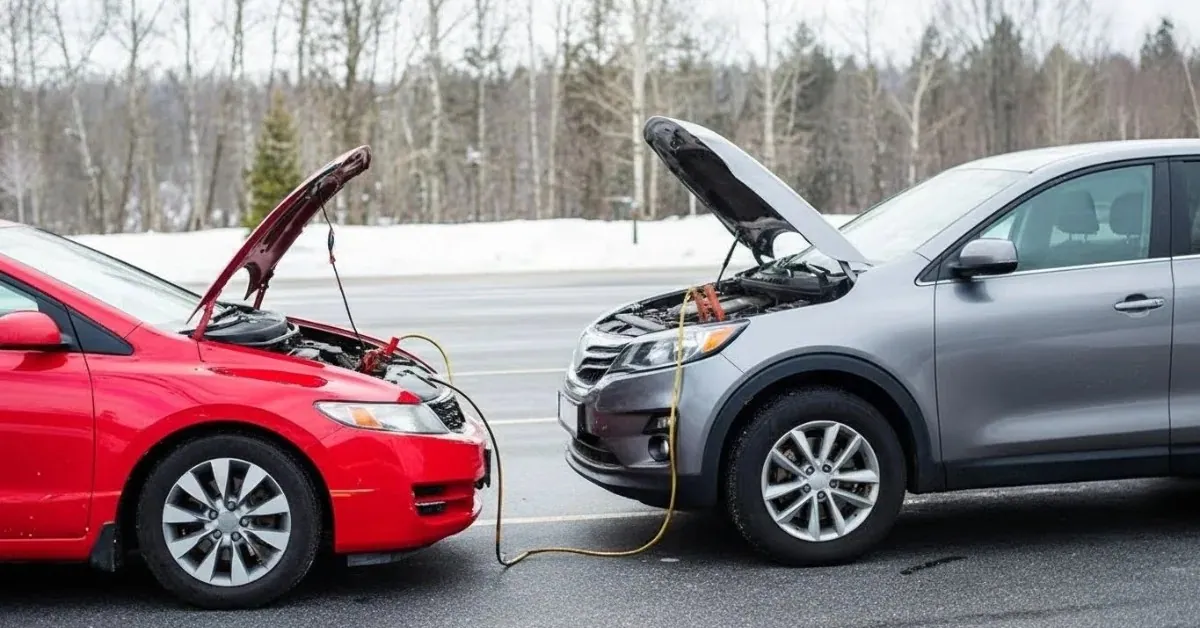
Using a booster pack is one of the handiest skills a motorist can have. Old-style jump-starting needs a second car and a helpful stranger; a modern portable jump starter lets you bring a dead battery back by yourself in minutes, and a good one protects the car's delicate electronics while it does so.
This walkthrough covers the lot: why batteries give up sooner in this climate, how to pick a pack, the boosting sequence one step at a time, the safety rules that matter, and how to tell when a replacement makes more sense than another boost.
Why Do Batteries Fail So Quickly Here?
Few climates on the planet are as hard on a battery as a Gulf summer. Gulf heat hastens the internal ageing of a lead-acid battery, and every summer week above 40°C takes something out of it. Between June and September, Dubai and the inland emirates routinely see 42°C to 48°C.
Six causes account for most failures:
- Intense heat: Above 40°C, the electrolyte evaporates faster and the plates corrode sooner. In a car parked in the sun, the battery itself can climb past 70°C.
- Brief urban trips: Crawling along Al Wasl Road or through Business Bay never gives the alternator time to top the battery back up. A healthy alternator needs 20 to 30 minutes of unbroken driving to refill a drained battery.
- Long spells parked: Two to 3 weeks without use is enough to flatten a battery unaided. A lead-acid battery at 25°C loses 3% to 5% of its charge each month by itself, and warmer weather speeds that up sharply, about twofold for each additional 10°C.
- Hidden drain: A dashcam, phone charger or aftermarket gadget left plugged in can pull 50 to 300 milliamps around the clock, which can leave a 60Ah battery too weak to start the car within days to a few weeks.
- Shorter service life: A battery that would give 4 to 5 years somewhere cooler usually dies within 2 to 3 years here, because the heat ages it faster.
- A weak alternator: One that undercharges leaves the battery sitting at 80% to 90% every day, which can cut its total life by up to 40%.
What Is a Booster Pack, and Why Keep One in the Car?
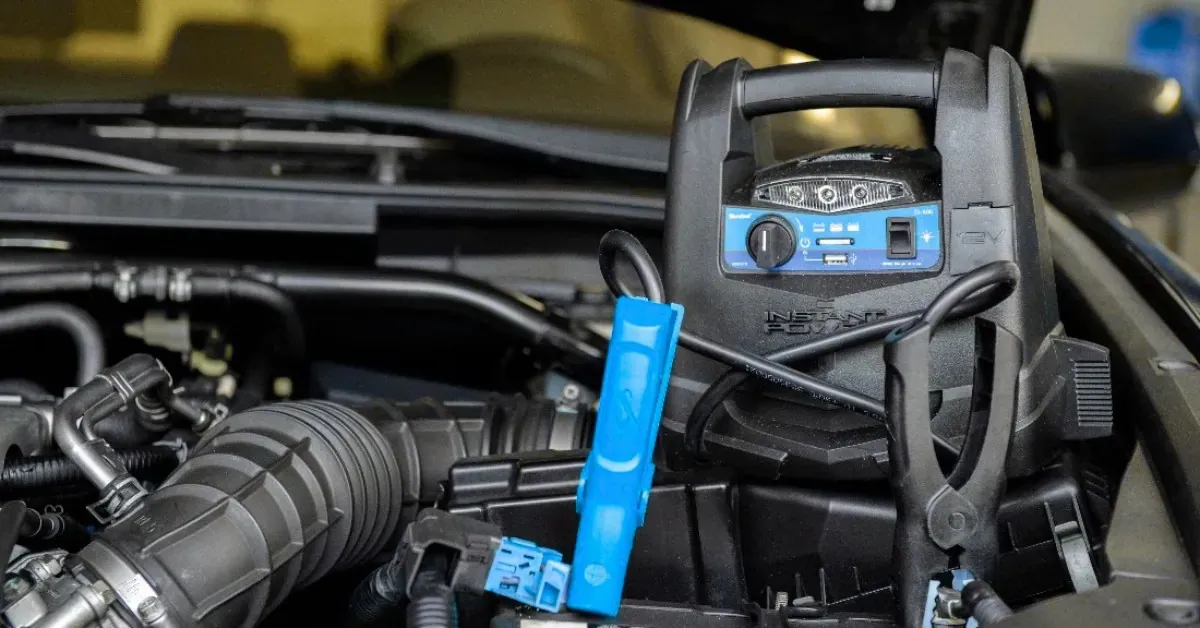
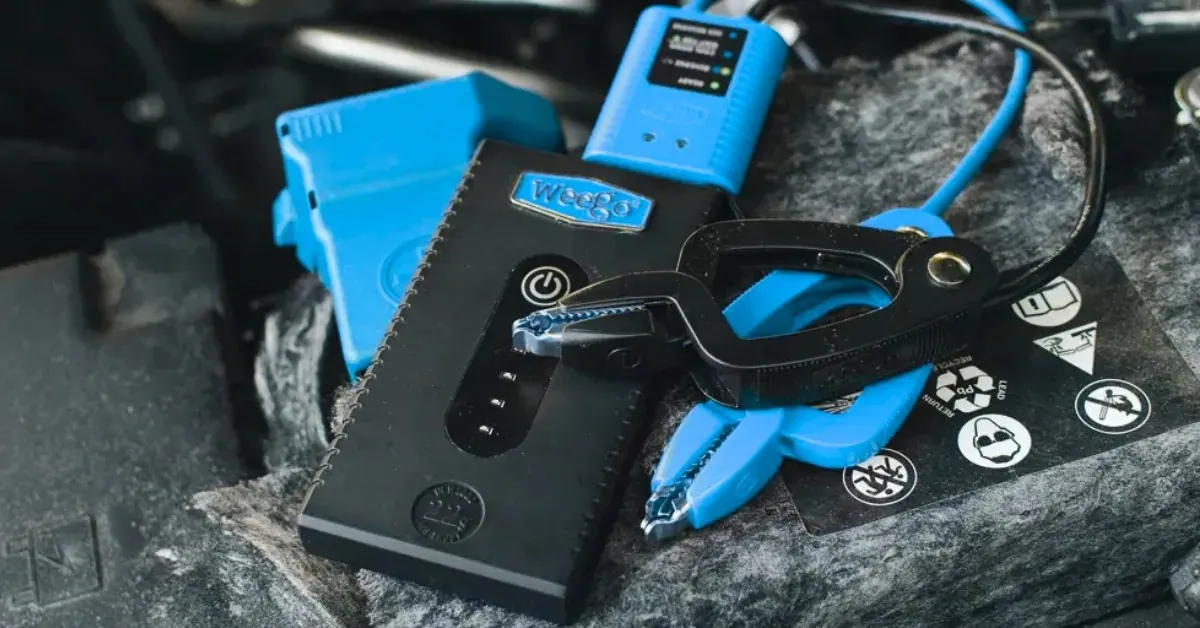
It is a portable, self-powered unit that supplies enough peak current to restart a car with a flat battery, no donor vehicle involved. You may also see it sold as a portable jump starter or a jump starter power bank. Energy is held in lithium-ion or lead-acid cells and released through heavy clamps that attach to the battery.
Compared with jump leads, which depend on another car, a pack gives you 4 clear benefits:
- Independent: Nobody else needs to stop for you, so it works in remote spots such as Liwa, Mleiha or the Hatta mountains.
- Gentle on electronics: Good units cut out on reversed polarity, excess current and short circuits, shielding modern ECUs that cost AED 3,000 to AED 15,000 to replace.
- More than a starter: Most lithium-ion models carry USB-A and USB-C sockets and double as a backup charger for phones and tablets.
- Small footprint: Current lithium-ion units weigh 500g to 1.2kg and slip into a glovebox or door bin.
Packs on sale today fall into 2 broad groups:
- Lithium-ion jump starters
Light units of 500g to 1.5kg that still put out 400 to 3,000 peak amps. They are the right choice for hatchbacks, saloons, SUVs and 4x4s, and they hold their charge for 3 to 6 months between uses. Used correctly, and with the pack's own protection circuits working, these cells deliver short high-current bursts safely.
- Lead-acid booster units
Bulkier packs of 4kg to 8kg that supply longer bursts of cranking current. They are aimed at big diesel lorries, fleet vehicles and plant machinery, and their weight makes them awkward for a private car.
For a typical driver, start at a lithium-ion pack of no less than 1,000 peak amps. For reference, a Land Cruiser 200 Series with the 4.6L V8 petrol needs at least 850A of cold cranking amps (CCA), and a 3.0L diesel Prado needs at least 950 CCA.
The 8 Steps to Boost a Car Battery With a Pack
Step 1: Make the Scene Safe
Check these points before you touch a clamp:
- Pull completely clear of the carriageway and the hard shoulder, above all on fast roads such as the E11 Sheikh Zayed Road, the E311 Emirates Road or the E66 Al Ain Road.
- Put an automatic in Park; in a manual, select first gear and pull the handbrake on firmly.
- Look the battery over. Leave it alone if the case is cracked, swollen, leaking or badly corroded: a bulging lead-acid battery can split under charging current and spray sulphuric acid (H2SO4) at 30% to 50% strength.
- Look for white or blue-green crust on the posts. That is lead sulphate and copper sulphate deposit, and it raises contact resistance and cuts the current that gets through, so wipe it off with a dry cloth or a wire brush first.
Step 2: Confirm the Pack Has Enough Charge
Only use the pack if its gauge reads 50% or more. At 20% it cannot supply the peak current most engines need. Plan to recharge it once a month, because lithium-ion cells lose charge faster once temperatures pass 35°C.
Go through the maker's handbook before the first use and note the peak amp rating, what each warning light means and what the USB outputs deliver.
Step 3: Attach the Clamps, Positive Before Negative
Getting the polarity right matters more than anything else in the process. Swap the clamps and you can wreck the ECU, the battery management system and the infotainment unit in a few milliseconds.
Work in this order:
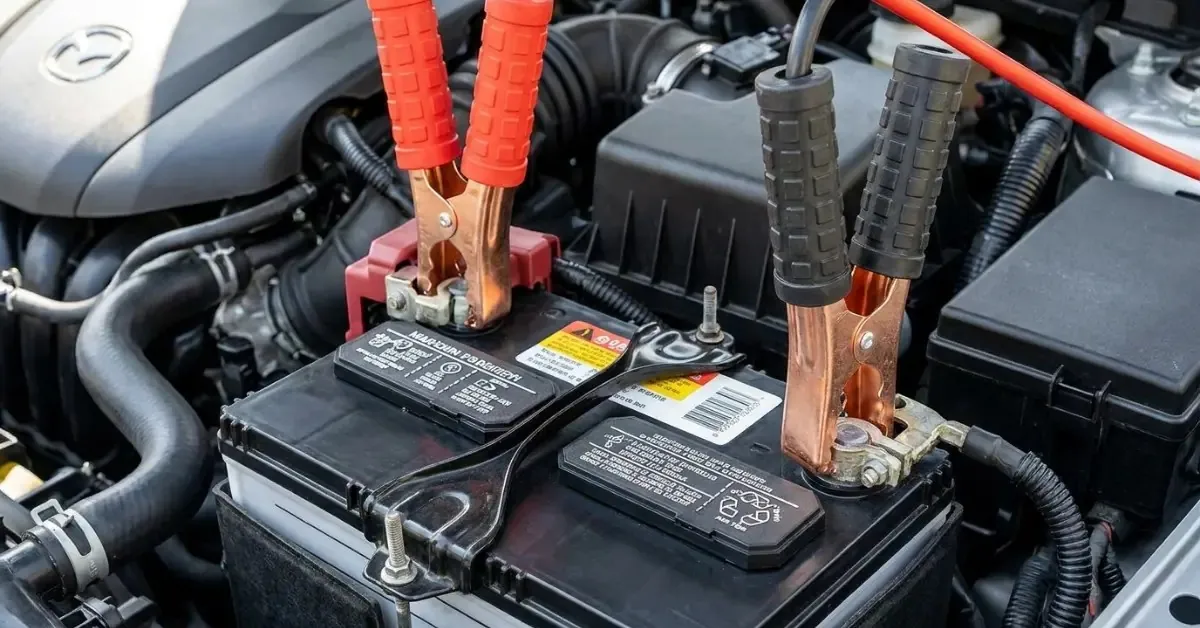
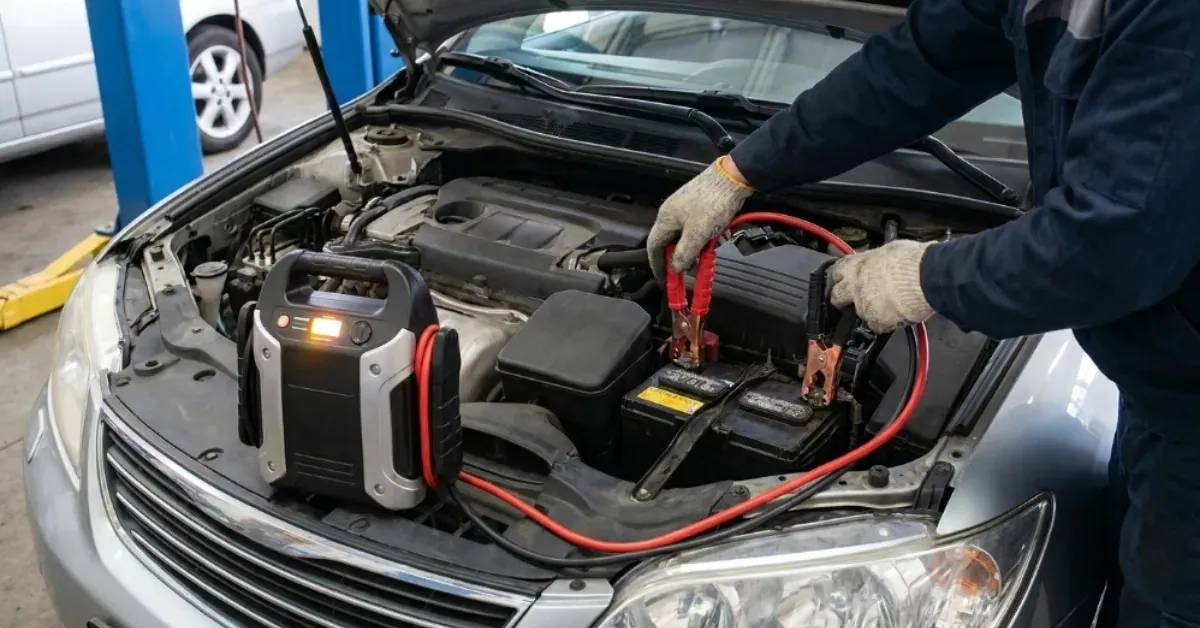
- Put the red (positive) clamp on the flat battery's positive (+) post, which carries a + mark or a red plastic cap.
- Put the black (negative) clamp on clean, unpainted metal on the engine, such as an alternator bracket, an engine mount bolt or a solid chassis rail, at least 30cm from the battery.
Keep the black clamp off the battery's negative post. Lead-acid batteries give off hydrogen (H2) as they charge and discharge, and a spark right at the post can set it alight. A spark near the battery's vents is a well-known cause of battery explosions.
In short: red on positive (+), black on bare engine metal, every single time.
Step 4: Switch the Pack On
Turn the unit on only once both clamps are firmly in place. A steady green light tells you the polarity and output are correct. A flashing red light or a beeping alarm means the clamps are the wrong way round or not biting properly, so take them off and check again before switching on.
Step 5: Give It 2 to 3 Minutes
Resist turning the key straight away. Waiting 2 to 3 minutes lets the pack feed some charge back into the drained cells, so the starter is not relying on the pack alone. In hot weather this pause gives you a better chance of a first-time start.
Step 6: Crank the Engine
Turn the key or press the start button. If the boost has worked, the engine spins over at normal speed and fires cleanly.
If it does not catch first time:
- Leave it 60 seconds, then try once more.
- Give up after 3 failed tries. The starter motor pulls several hundred amps while it turns and is only designed for bursts of 15 to 30 seconds, so more cranking will overheat it.
- Look at the pack's gauge. Below 50%, the attempts may simply have drained it.
- If a fully charged pack still cannot crank the engine after 3 tries, the battery is beyond saving, or the fault lies in the starter, the fuel supply or the ignition.
Step 7: Remove the Clamps, Negative Before Positive
Undoing the connection backwards stops a voltage spike from reaching the electronics. Reverse the order you used to connect:
- Take the black (negative) clamp off the engine block.
- Then take the red (positive) clamp off the battery post.
- Put the leads away so the two jaws cannot touch.
Step 8: Keep Driving for 20 to 30 Minutes
Once running, head for a main road and keep moving, without stops, for 20 to 30 minutes. While you drive, the alternator puts 13.8V to 14.7V back into the battery; stop-start town traffic will not do the job. Emirates Road is ideal; Al Khail Road works too, as does Sheikh Mohammed Bin Zayed Road. Keep the air conditioning, the stereo and other heavy loads off for the first 10 minutes.
What You Need to Test the Battery at Home
Checking a car battery yourself takes only a handful of tools. Set up properly, you can read its voltage accurately and judge its condition in a few minutes.
- A digital multimeter (reads the 0 to 20V DC range precisely, which suits a 12V car battery; a decent model such as the Fluke 101 or AstroAI DT132A is ideal)
- Protective gloves (keep sulphuric acid and live contacts off your skin)
- Eye protection (guards against sparks and splashes of corrosion)
- A clean rag or wire brush (clears corrosion from the posts, which can distort the reading, sometimes 0.2V to 0.5V off)
- A spanner (tightens loose clamps so the reading holds steady)
- A baking soda mix (1 tablespoon of baking soda stirred into 250ml of water, for cleaning corroded posts)
Tip: pick a digital meter over an analogue one. It reads to 0.01V, so there is far less room for error.
Safety Rules You Should Never Skip
Stick to all 7 of these on every boost:
- Put on insulated gloves if you have them. The posts carry 12V DC at high current, and touching them under load can cause serious burns.
- Place the pack on flat ground at least 30cm from the battery, away from any hydrogen the cells release.
- Keep your face and body out from over the battery while clamps go on or come off.
- Keep children well away from the engine bay from start to finish.
- No cigarettes and no naked flames anywhere near. Hydrogen from a lead-acid battery ignites anywhere between 4% and 74% concentration, and it collects in enclosed spaces.
- On a summer day, let a very hot battery cool for 10 to 15 minutes before you boost it. Charging one above 50°C speeds up plate damage and makes a rupture more likely.
- Clean off corrosion before connecting. A furred-up post resists current, weakens the boost and can arc where the clamp bites.
Errors Drivers Make With Booster Packs
Error 1: Putting the Black Clamp on the Negative Post
That puts a possible spark right where the hydrogen gathers. Earth the negative clamp on the engine block instead.
Error 2: Buying a Pack That Is Too Small
A 400-peak-amp unit will start a Honda City and do nothing for a Land Cruiser 200 V8. Size the pack to the CCA your engine needs: a 5.7L V8 wants at least 1,500 peak amps.
Error 3: Forgetting to Check the Pack's Charge
With only 20% left, a pack cannot crank most engines of 2.5L and above. Glance at the gauge before you need it, and recharge it every month so it is never caught short.
Error 4: Unclipping the Second the Engine Fires
Yanking the clamps off at the instant of start-up can send a voltage spike through the system. Let it idle for 10 to 15 seconds, then disconnect in order.
Error 5: Assuming the Boost Has Fixed Things
A boost only gets you going again; a worn battery stays worn. Book a professional load test within 24 to 48 hours of any boost, and if the battery manages less than 70% of its rated CCA, replace it straight away.
Which Pack Suits Local Conditions?
Packs that are fine in Europe can struggle in this heat. Look for units built to run at high temperatures and to keep dust out.
Peak amps needed for each kind of vehicle:
| Vehicle | Engine Capacity | Peak Amps (at least) |
|---|---|---|
| Compact saloon (Toyota Yaris, Honda City) | 1.3L to 1.5L | 600A |
| Family saloon (Toyota Camry, Nissan Altima) | 2.0L to 2.5L | 800A |
| Medium SUV (Toyota Fortuner, Mitsubishi Pajero) | 2.7L to 3.0L | 1,000A |
| Large 4×4 petrol (Land Cruiser 200 V8) | 4.6L to 5.7L | 1,500A |
| Large diesel (Prado 3.0D, Patrol 2.8D) | 2.8L to 3.0L | 1,200A |
| Diesel lorry or commercial vehicle | 5.0L+ | 2,000A+ |
Check for these 5 specifications at the shop:
- Heat tolerance: Rated to work in at least 60°C ambient. Ordinary lithium-ion cells deteriorate beyond 45°C, so choose a unit with its own thermal management.
- Protection circuits: Reverse polarity, over-current, over-voltage and short-circuit protection are a must on modern cars with CAN bus electronics.
- A capacity of 20,000mAh to 30,000mAh: Enough for 15 to 30 boosts on one charge, which matters on long desert drives far from any help.
- An IP65 rating or better: Fine sand kills unsealed electronics. IP65 means fully dust-tight and able to shrug off low-pressure water jets.
- USB-A and USB-C outputs: A 20,000mAh unit can refill a smartphone 5 to 7 times, so it earns its place in an emergency even when the car starts.
When a Boost Will Not Do: Signs You Need a New Battery
Change the battery now if any of these 7 apply:
- You have needed a boost more than 2 times in 30 days.
- It is 3 years old or more, or 2 years old if you commute long distances every day in the heat.
- The headlights dim clearly whenever the engine idles below 1,000 RPM.
- The battery warning lamp is still lit after a boost and 30 minutes on the road.
- The case is hot to touch after only a short journey.
- A load test by a professional shows under 70% of the rated CCA.
- The casing is cracked, bulging or stained with acid.
In this climate a battery rarely fades slowly; it tends to die all at once. One at 60% health in May may be completely dead by July. Heat damage builds on itself, so once a battery starts to decline in high summer, the end usually comes quickly.
Looking After the Battery Season by Season
April to September: the Hot Months
- Use covered or shaded parking whenever you can, such as the Dubai Mall basement, Mall of the Emirates or the covered floors at Mirdif City Centre.
- Start the car at least every 5 consecutive days rather than leaving it standing longer.
- On a battery with removable caps, check the electrolyte every 4 to 6 weeks and top up with distilled water only. Local tap water carries dissolved minerals that contaminate the electrolyte and hasten sulphation of the plates.
- Get a load test done before June, since summer brings more battery failures across the country than any other season.
- In July, the battery in a parked car can go beyond 70°C inside. Most lead-acid batteries are rated to a maximum of 40°C to 50°C, so that is well outside their safe range.
October to March: the Cooler Months
- Lower temperatures are far kinder to a battery: the heat wear that shortens its life slows right down once the air stays below 25°C, compared with months spent near 45°C.
- High ground such as Jebel Jais in Ras Al Khaimah and Hatta can fall to 2°C to 5°C overnight in December and January, and near 0°C a battery loses 20% to 30% of its CCA. Charge the pack fully before a mountain or desert camping trip.
- Winter is the ideal time to fit a replacement. A battery installed in October goes into the next summer at full strength.
Final Word: Get Ready Before It Happens
Sooner or later, almost every driver ends up with a flat battery. Heat, city driving, long empty roads and fine desert dust wear it down every day of the year.
Whether that day costs you 10 minutes or turns into a stressful and costly roadside ordeal depends on how prepared you are. A good pack in the boot, and knowing how to boost a car battery with it, means you can sort it out wherever you happen to be.
We keep packs that are tested for local conditions, quality car batteries for every make and model, and a team ready to advise, at our workshop or at your door.
Your Questions Answered
Will an ordinary pack work on an AGM battery?
In most cases, yes. Nearly all current lithium-ion packs handle both flooded lead-acid and AGM (Absorbed Glass Mat) batteries, which newer European cars from Volkswagen, Audi, Mercedes-Benz and BMW now come with as standard.
Look for AGM support on the pack's specification sheet before you connect it, as some AGM setups need a dedicated AGM boost mode.
If yours is past 2 years old, has spent those years baking in Dubai, and you would like more certainty than a simple voltage figure gives, the sensible next move is a conductance test carried out by a professional.
Ring our team and we will come out and run a free battery health check on the spot. Parked at a villa in Arabian Ranches, outside a DIFC office tower or stuck beside Emirates Road, our technicians come to you with professional diagnostic kit and a full range of battery brands, and they will have you moving again quickly.
How often can one battery be boosted before it has to go?
There is no set limit, but needing more than 2 boosts within 30 days is a clear sign the battery is on its way out and due for replacement. Every deep drain and boost strains the lead plates and the electrolyte, and a battery that keeps needing help usually tests at under 60% of its rated capacity under load.
Is boosting safe in the height of a Dubai summer?
It is, as long as the battery shows no damage and you keep to all 7 safety rules. Do not boost one that is very hot to touch; give it 10 to 15 minutes to cool. Charging with the inside of the battery above 50°C raises the risk of the electrolyte boiling and the plates being damaged for good.
Can a pack start a diesel?
It can. A diesel needs far more cranking current than a petrol engine of the same size, so use at least 1,200 peak amps for a 3.0L diesel such as a Land Cruiser Prado or a Mitsubishi Pajero 3.2 DID, and 2,000 peak amps or more for commercial diesels above 5.0L.
Could a boost harm my car's electronics?
Not if you do it properly with a good pack that has surge and reverse polarity protection built in. Cars with CAN bus wiring and several ECUs are vulnerable to spikes above 16V.
Battery trouble in Dubai? We come to you.
On-site testing, replacement and roadside help, 24/7 across the city.