The short answer
Knowing how your battery is kept topped up on the road is more than trivia. The job falls to the alternator, which turns the engine's mechanical energy into electricity at 13.8V to 14.4V DC and puts back the charge that starting the car used up. In the UAE, with summer temperatures above 45°C and crawling traffic every day, that cycle works under constant pressure.
Below we walk through each stage of the process, explain how heat and driving patterns change the picture, and show when a battery needs a proper inspection rather than one more drive.
Which Part Refills the Battery Once the Engine Is Running?
The engine does not charge the battery directly; the alternator does. It is a generator bolted to the engine block and driven by the serpentine belt, which some manuals simply call the drive belt.
As the engine turns, the belt spins the rotor inside the alternator. That movement generates alternating current (AC) by electromagnetic induction, the principle Michael Faraday described in his law of induction in 1831.
- Making AC: the turning rotor produces alternating current (AC) within the alternator
- Turning it into DC: rectifier diodes change that AC into direct current (DC), the form a battery can store and use
If the alternator stops working, even a battery fresh out of the box will run flat on the move before long, because the ignition, fuel pump, fans and lights then draw on it alone.
Stage by Stage: What Happens From Key Turn to Full Charge
Step 1: Starting the Engine Takes Energy Out
Cranking pulls a surge of 150 to 600 amperes (A) from the battery, the amount depending on engine size. That surge is why batteries carry a cold cranking amps (CCA) rating, and it takes a noticeable bite out of the charge in just 2 to 3 seconds.
Cycling a battery at a low state of charge (SOC) again and again lets sulphate crystals harden on the lead plates, and that lost capacity does not come back; heat makes the process quicker.
Each start leaves the battery a little lower, and the charging that follows exists to replace what was spent.
Start-up is where a failing battery first gives itself away:
- Slow cranking, with the starter motor turning lazily
- A pause before the engine catches
- One click or a series of clicks (not enough CCA)
Step 2: Within Seconds, the Alternator Takes Charge
Within 2 to 3 seconds of the engine firing, the alternator is in charge. The belt turns the rotor inside the stator windings faster than the crankshaft, thanks to its smaller pulley, creating AC voltage. The rectifier, 6 diodes wired as a 3-phase bridge, then smooths it into steady DC.
Diode rectification of this kind is what let the alternator replace the old DC dynamo in cars during the 1960s. In a healthy system, current starts flowing back into the battery seconds after start-up.
Step 3: The Voltage Regulator Keeps Output in Range
The regulator holds the alternator's output between 13.8V and 14.4V for conventional flooded lead-acid (FLA) batteries, and as high as 14.7V for absorbent glass mat (AGM) types. It checks the voltage hundreds of times a second using pulse-width modulation (PWM) and trims the rotor's field current to suit.
Push an FLA battery past about 15V and you get heavy gassing, water loss and grid corrosion, and in the worst case thermal runaway.
When a regulator starts to fail, 4 symptoms you can measure tend to appear:
- The battery warning lamp stays lit while you drive.
- Headlamps flicker or brighten and dim as engine speed changes.
- The battery shows full, yet it is flat after a night parked.
- Electrics act strangely: the radio resets, the windows move slowly.
Step 4: The Current Is Shared Between the Battery and Everything Switched On
Alternator output is divided between 2 jobs at once: refilling the battery and running every live system, from the HVAC compressor, ECU and infotainment to the LED headlamps, ADAS sensors and electric power steering. Most passenger-car alternators are rated at 80A to 150A. Performance SUVs with big screens or Level 2 ADAS carry units rated at 200A or more.
With the air conditioning on full in summer, the compressor clutch, blower and condenser fans all add electrical load. Add headlamps (8 to 12A), infotainment (5 to 10A) and the rear demister (15 to 25A) and accessories can take 50 to 60A, leaving very little spare for the battery in stop-start traffic.
Step 5: The Energy Is Stored as Chemistry
Inside a lead-acid battery, the incoming electricity is turned into chemical potential energy by an electrochemical reaction. While it charges:
- The positive plates (lead dioxide, PbO₂) are oxidised further.
- The negative plates (sponge lead, Pb) are reduced as sulphate ions (SO₄²⁻) go back into the electrolyte.
- The electrolyte (sulphuric acid, H₂SO₄) recovers its specific gravity, climbing from 1.10 to 1.28 g/cm³ when full.
The Peukert equation for lead-acid batteries describes the non-linear link between how fast a battery is discharged and how much capacity it can deliver. Heat speeds up plate corrosion and water loss, so a battery working through UAE summers above 45°C ages far faster than the 25°C test conditions behind European ratings would suggest.
Step 6: Charging Carries On Until the Battery Is Full or the Engine Stops
Current keeps flowing at a controlled rate until the battery hits 100% state of charge (SOC). The regulator then drops to a float voltage of 13.2V to 13.4V so it is not overcharged. Fully charged, a 12V battery measures 12.6V to 12.8V at rest, rising to 13.8V to 14.4V once the engine runs.
As soon as the ignition goes off, charging ends. From then on self-discharge sets in: 3 to 5% monthly at 25°C, and each extra 10°C of heat about doubles that pace, so it climbs steeply in 40°C-plus conditions.
Why UAE Conditions Make the Job Harder
Heat Wears Out the Drive Belt Sooner
In summer, temperatures under the bonnet routinely pass 80 to 95°C, and EPDM rubber serpentine belts harden, crack and slip. A slipping belt can slow the alternator rotor by up to 40%, and charging output drops in step.
Gates, the belt maker, reports that belt life is roughly halved by every 10°C rise in belt temperature. Here, inspect the belt every 20,000 km and replace it every 2 years.
Dust and Sand Block the Alternator's Cooling
Air flowing through the alternator's vents carries away the heat created by the 10 to 15% of energy lost converting AC to DC. Fine desert dust (PM2.5 to PM10 particles) clogs those slots and can push winding temperatures past the 180°C insulation rating of Class H windings. Clean the vents every 10,000 km, or sooner after a heavy sandstorm.
Crawling Traffic Stops the Battery Catching Up
With the engine idling at 600 to 800 RPM, the pulley ratio spins the alternator rotor at roughly 1,500 RPM, good for only 30 to 50A of output. With the AC on, that barely covers the accessories and leaves almost nothing over for the battery.
City trips of under 15 to 20 minutes rank among the 3 most common reasons batteries fail early. Give the car at least 1 highway run a week lasting 30+ minutes at steady revs so the battery can fully recover.
Hot Air Speeds Up Self-Discharge
Left in full Dubai summer sun, a car's cabin reaches 70 to 80°C. Because each extra 10°C about doubles the pace, a battery that hot loses charge many times faster than its normal 3 to 5% per month.
Leave a car uncovered for 5 to 7 days in summer and the battery can sink below 11.8V, into the deep discharge zone where permanent sulphation sets in. Use shaded or covered parking wherever you can.
Is Your Charging System Doing Its Job? How to Check
A 30-Second Look at the Dashboard
- Battery warning lamp: it should glow briefly when you start and go out within 3 seconds. If it stays on while you drive, the charging system has a fault.
- Voltmeter or voltage readout: expect 13.8V to 14.4V while moving (up to 14.7V on some AGM cars). Anything under 13.5V with the engine running points to an undercharging alternator.
A 5-Minute Multimeter Test
All you need is a digital multimeter, which any UAE car accessories shop sells for under AED 30:
- Engine off: a sound battery sits at 12.6V to 12.8V
- Engine at 1,500 to 2,000 RPM: expect 13.8V to 14.4V from a sound charging system
Load test: switch on the headlamps, AC and rear demister together, and the reading should hold above 13.5V. If it falls under 13V, the alternator is struggling.
When Is a Drive No Longer Enough to Recharge the Battery?
Driving can only top up a battery that is basically sound. A worn one loads the alternator harder and shortens its life, and a new alternator in the UAE runs to AED 800 to AED 2,500, against AED 250 to AED 650 for a new car battery.
Stop counting on the drive home to fix things if any of these 5 apply:
- The battery has served beyond 3 years in UAE conditions (the 5-year European ratings assume 25°C, not 45°C).
- It has been deeply discharged (under 10.5V) more than 2 to 3 times, leaving permanent sulphation.
- The car still struggles to start after a 30-minute highway drive, so the battery is not keeping its charge.
- A conductance tester (Midtronics MDX-P300 or similar) reports under 70% of rated capacity.
- The warning lamp clears on the road but comes back after the car sits overnight
Replace it rather than trying to make up the difference with longer journeys.
Charging Mistakes We See All the Time
- Sticking to short hops. With trips under 15 minutes the battery never catches up between starts, and over 3 to 4 months the partial cycling and sulphation get steadily worse.
- Leaving the car parked over Eid or the National Day break. In summer, just 4 to 5 days standing can take a borderline battery under the safe 11.8V mark.
- Driving on with the battery lamp lit. A lamp that stays on is reporting a fault, and it will not clear by itself.
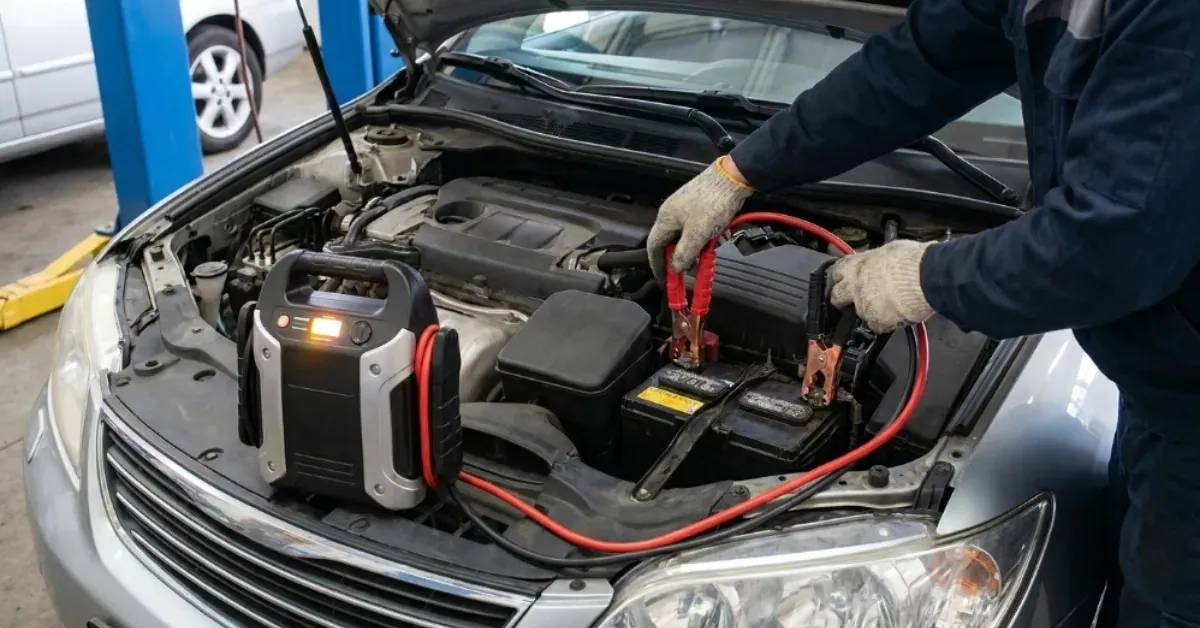
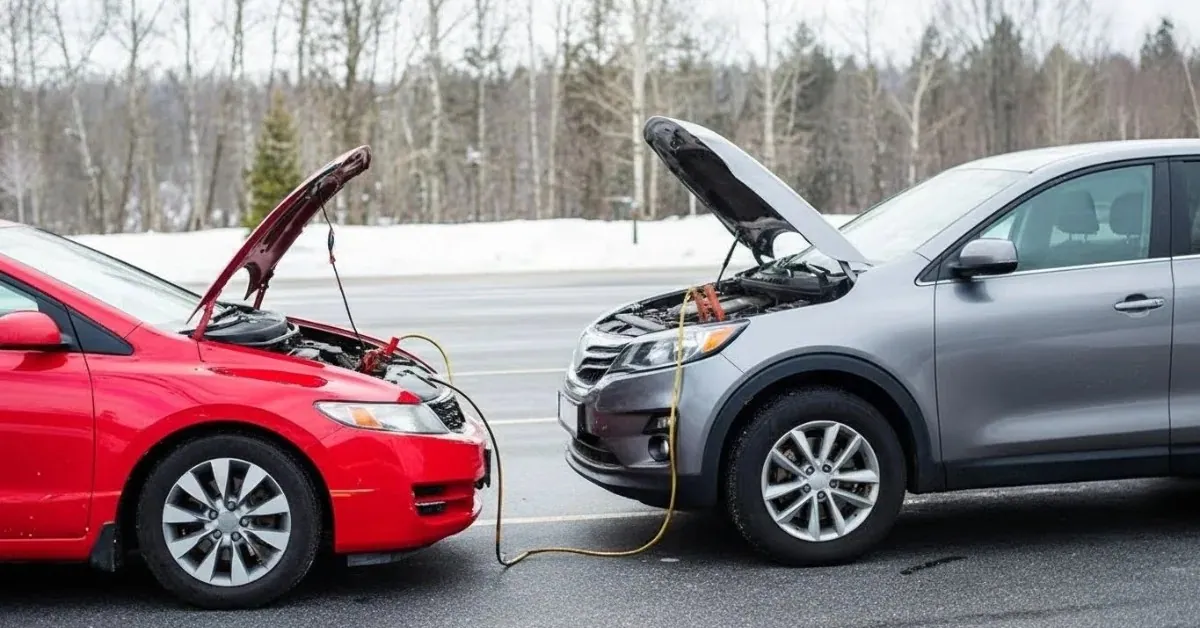
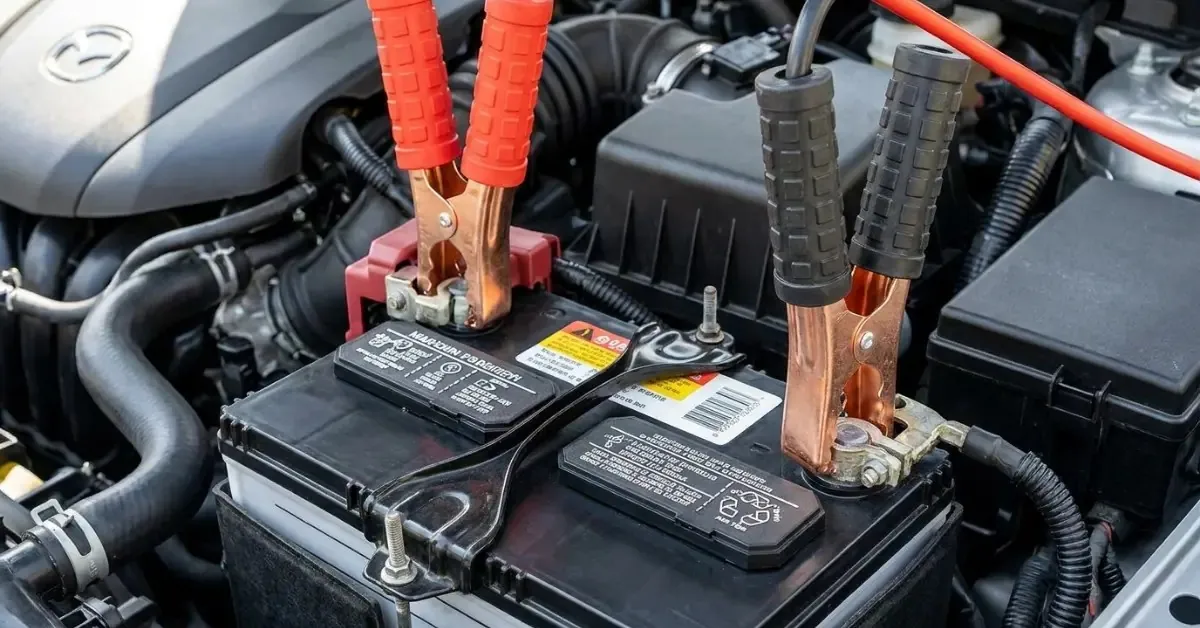
- Treating a jump-start as the cure. It gets you moving for now but leaves the cause untouched, so book a full check of the charging system afterwards.
- Running heavy loads with the engine off. The rear demister pulls 15 to 25A and the AC blower 10 to 15A; with the ignition on and the engine stopped, the pair can drag a standard 60Ah battery dangerously low in 45 to 60 minutes.
Driving Habits That Keep a Battery Charged Through a UAE Summer
- Twice a week or more, keep the car moving 20 to 30 minutes without a break, on highways where steady revs let the alternator work at full efficiency.
- Switch off the rear demister and turn the AC fan down if you will idle for more than 5 minutes.
- Park in covered or shaded spots so the battery stays under 40°C between drives.
- Twice a year (every 6 months), inspect both posts for white or green sulphate crust, which adds resistance and can cut charging efficiency by up to 20%
- Book a battery health check each March or April, ahead of peak summer electrical load.
- Clip on a smart maintainer (CTEK MXS 5.0 or similar) whenever the car will sit idle beyond 5 days.
How Much Driving Does a Full Recharge Take?
A battery charged while driving needs 15 to 20 minutes on the highway after a light discharge such as a normal start, and 90 to 120 minutes after a deep discharge. A badly degraded battery may never fully recover, however long you drive.
| How Far It Was Drained | Highway Driving (100+ km/h) | City Driving (stop-start) |
|---|---|---|
| Light (after an ordinary start) | 15 to 20 minutes | 30 to 40 minutes |
| Moderate (after a run of short trips) | 30 to 45 minutes | 60 to 90 minutes |
| Deep (battery almost flat) | 90 to 120 minutes | Full recovery unlikely |
These timings assume a healthy battery with 80%+ capacity. An ageing one may take the current but fail to keep it, looking fine until it dies again a few hours after you park.
Symptoms That Mean the Charging System Needs Checking Today
Have the system looked at straight away if you notice any of these 7 signs:
- The battery lamp stays on as you drive.
- Headlamps clearly weaker than normal, especially at idle
- The engine turns over slowly or without its usual force.
- Electrics drop out or reset without warning, such as the radio or electric windows.
- A smell of burning rubber under the bonnet, a sign of a slipping serpentine belt
- The car cuts out on the move (an alternator failure rather than a battery one)
- More than one jump-start needed inside any 30-day window.
Just one of these justifies an inspection the same day.
Keeping Drivers Charged Across Dubai and Beyond
We know the 3 particular pressures that local roads, weather and driving habits put on a charging system: heat above 45°C, fine desert sand, and endless short-trip cycling. Whether you commute on the E11 every day, do the school run in Jumeirah or head out to Hatta at the weekend, your battery and alternator should be in a condition that has been measured and confirmed.
Our battery health check covers alternator output, the voltage regulator, the drive belt and a test with professional conductance equipment. You get a full SOC and state of health (SOH) report, not a bare pass or fail.
Get in touch with us to book a battery and charging system inspection. Our mobile service covers Dubai and Sharjah.
Questions Drivers Ask Us
Will the battery charge with the engine just idling?
Yes, though only slowly. Idling, the alternator gives a mere 30 to 50A, which may hardly cover the AC, headlamps and other accessories running together. In UAE summer heat, long periods of idling achieve far less than a steady highway drive above 80 km/h.
If your battery is over 2 years old, has lived through Dubai summers and you want a firm answer rather than a lone voltmeter figure, a conductance test from a trained technician comes next.
Ask us for a free battery health check at your location. Villa in Arabian Ranches, desk in a DIFC tower, or parked up beside Emirates Road: the team arrives with pro-grade diagnostic tools, plenty of battery brands and the experience to get the car moving again fast.
How long do I need to drive after the battery went flat?
For a deeply drained battery, allow a highway drive of 90 minutes or more. If it has been run that low more than 2 to 3 times, driving alone may not bring it back, and an external smart charger or a professional load test is the better next step.
Can a very long drive harm the battery?
No. When the battery reaches full SOC, the regulator falls back to float voltage (13.2V to 13.4V) and overcharging is prevented. A long run does a healthy battery no harm.
I drive daily, so why does the battery keep dying?
If most daily trips last under 15 to 20 minutes, the battery never regains what each start takes out. That repeated partial cycling speeds up sulphation and is one of the 3 most common causes of early battery failure among city drivers in the UAE.
What voltage should the battery show on the move?
With a healthy charging system, expect 13.8V to 14.4V while driving. Readings that stay under 13.5V with the engine running indicate a charging fault that needs checking straight away.
Battery trouble in Dubai? We come to you.
On-site testing, replacement and roadside help, 24/7 across the city.