The short answer
A flat or failing battery is among the problems UAE drivers meet most often at the roadside. Dubai and Sharjah summers routinely climb beyond 45°C, and that heat makes batteries give up far sooner than they would elsewhere.
You can find out for yourself whether the battery is to blame, with no mechanic involved. The multimeter check takes 6 steps: clear the surface charge, look the battery over, set the meter to 20V DC, attach the probes, read the voltage, then run a cranking test. In a garage or on the driveway it needs less than 5 minutes.
What Do You Gain From a Home Battery Test?
A quick test on your own driveway spots a weakening battery before it strands you. The voltage figure also tells you plainly whether a charge will do or whether the unit has to go.
- Service life: Most batteries give 3 to 5 years where the climate is mild, and often only 2 to 3 years in hot countries.
- Full charge: A battery in good health shows 12.6V to 12.8V once topped up.
- Early warning: Once the reading slips under 12.4V, the battery is starting to lose performance.
- Failure line: Anything under 12.0V means a weak or flat battery.
- Starting load: While the engine turns over, the reading has to hold at 9.6V or above for a reliable start.
- How often: A check every 3 to 4 months catches most failures before they happen.
- Money saved: Catching a fading battery early lets you replace it on your own schedule instead of paying for an emergency call-out.
Why Do UAE Summers Kill Batteries So Quickly?
Where the weather is temperate, a typical battery keeps going for 4 to 5 years. Here it often manages only 2 to 3 years, and less again on a car that bakes in open sun every day.
Heat speeds up the chemistry that wears a battery out, following the same Arrhenius rule that makes most chemical reactions run faster as they warm. On a hot Dubai afternoon the engine bay can pass 80°C. Inside the case, that heat does four things:
- It speeds up the internal chemistry, so the plates and separators wear out sooner.
- It boils off electrolyte. In a flooded lead-acid unit the acid and water mix evaporates in extreme heat, the level falls and the plates are left exposed.
- Short journeys never refill it. Refilling a drained battery takes 30 minutes or more of steady engine speed, with the crank turning 1,500 to 2,000 revolutions a minute, and hops between the office, the school gate and the mall seldom give it that.
- A parked car loses charge on its own. Standing at 25°C, it sheds a few per cent of its charge each month, and at 40°C and above it loses it several times faster.
So test at least twice a year: once in April, ahead of the worst heat, and again in October as it eases.
How Does a Battery Tell You It Is Failing?
Before you get the meter out, watch and listen for any of these 8 clues:
- The engine turns over slowly and with effort (usually the first clue you get)
- A click, either one loud one or a fast chatter, as you turn the key
- Headlights or cabin lights looking weak, most obvious after dark
- A battery warning glowing on the instrument cluster.
- Electrics acting strangely: windows crawling up or the screen restarting on its own
- A case that has swollen or bulged (overcharging or thermal runaway; leave this one alone and do not test it yourself)
- White or bluish-grey crust on the terminals
- A smell of rotten eggs near the battery (hydrogen sulphide from a cell that is breaking down)
Take care: a bulging case or a sulphur smell means gas or internal damage. Skip the home test entirely and get the car to a professional straight away.
What Equipment Do You Need?
The kit is short and inexpensive. Set it up properly and you will have an exact voltage and a verdict on the battery in a few minutes.
- A digital multimeter covering 0 to 20V DC, which suits a 12V battery (a Fluke 101 or an AstroAI DT132A is a sound choice)
- Protective gloves, against acid on the skin and accidental contact
- Eye protection, in case of a spark or a splash of corrosion
- A rag or wire brush to clear terminal corrosion, whose film can skew the reading 0.2V to 0.5V
- A spanner to tighten any loose clamp so the reading is steady
- Baking soda and water for cleaning, mixed at 1 tablespoon to 250ml
Pick digital over analogue. A digital meter reads to 0.01V, which removes most of the guesswork.
Testing a Car Battery With a Multimeter, Step by Step
Work through the steps in this order, or the figure you get may mislead you.
Step 1: Protect Yourself
Gloves and glasses go on before you touch the battery. Stop the car on level ground and switch the engine off fully. No smoking and no naked flames nearby: a battery gives off hydrogen when it charges, and in severe heat it can do so while discharging too. In an enclosed garage, open a door or a window to let air through.
Step 2: Get Rid of the Surface Charge
Plenty of people miss this out, and their reading is wrong as a result.
After a drive, run the headlights for 2 minutes and turn them off. Driving leaves a surface charge that can make the voltage look 0.1V to 0.3V higher than it really is, and the lights burn it off. Give it 5 minutes before the meter goes on.
Better still, take the reading in the morning before anyone has started the car. That gives the truest resting figure.
Step 3: Find the Battery and Look It Over
Open the bonnet. On most cars sold here, the Toyota Land Cruiser, Nissan Patrol, Kia Sportage and Hyundai Tucson among them, the battery sits in plain view in a corner of the engine bay. Several European models, BMW and Mercedes-Benz for instance, give you only a remote positive post for jump-starting under the bonnet and put the battery itself in the boot or beneath the back seat. The owner's handbook will show you where.
Check for 3 things before you connect the meter:
- White or bluish-grey powdery build-up on the terminals
- Splits, swelling or seepage anywhere on the case
- Clamps that move when you wiggle them
Clean corroded posts before testing. Dissolve baking soda in water, 1 tablespoon per 250ml, then work it in with an old toothbrush, rinse sparingly and dry well. Left in place, the corrosion adds resistance and gives you a false voltage.
Step 4: Prepare the Meter
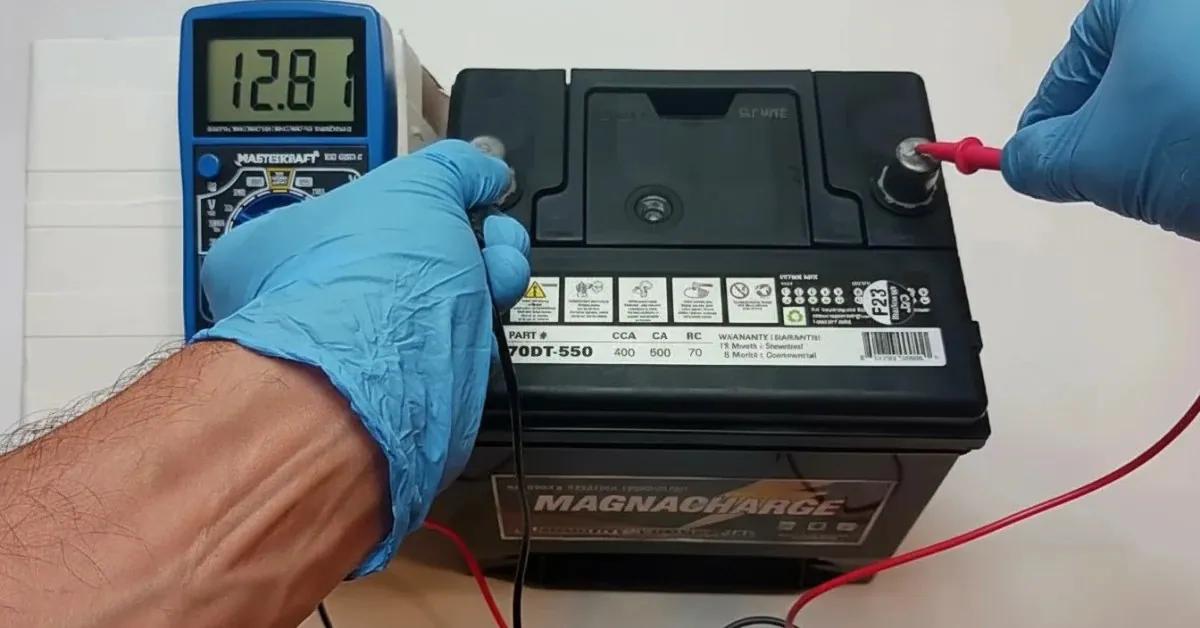
Turn the dial to DC volts, the V with a straight line beside it, and pick the 20V range, which is fine enough for a 12V battery. An auto-ranging meter only needs DC volts selecting.
Stay off the AC setting. A car battery supplies direct current, and on AC the meter will show a misleading zero.
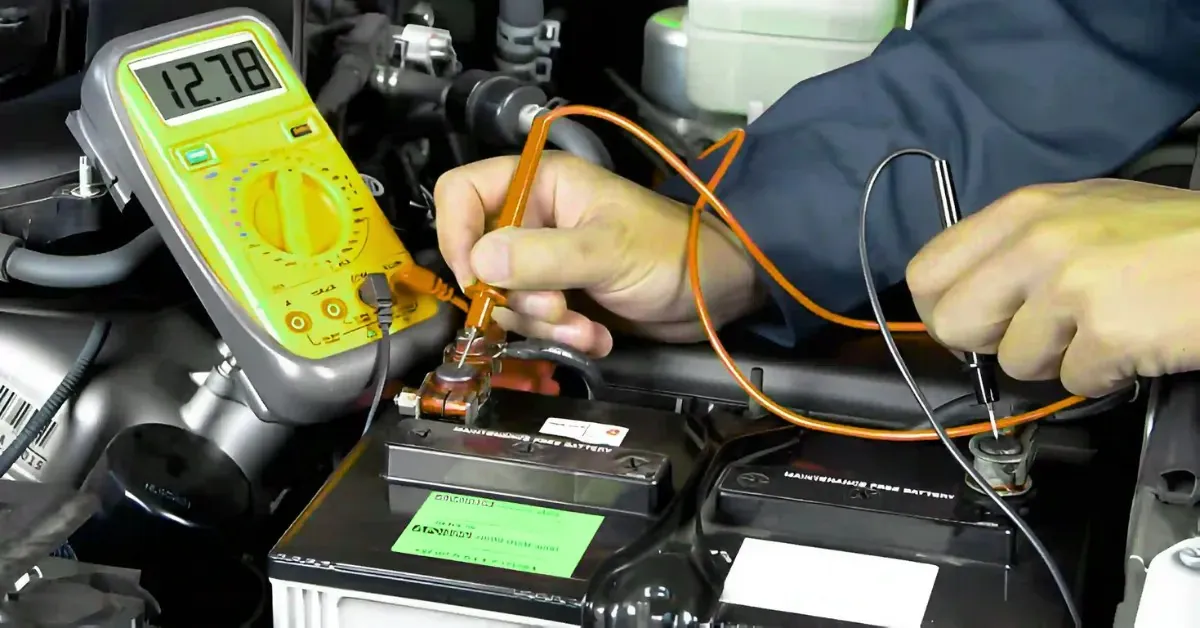
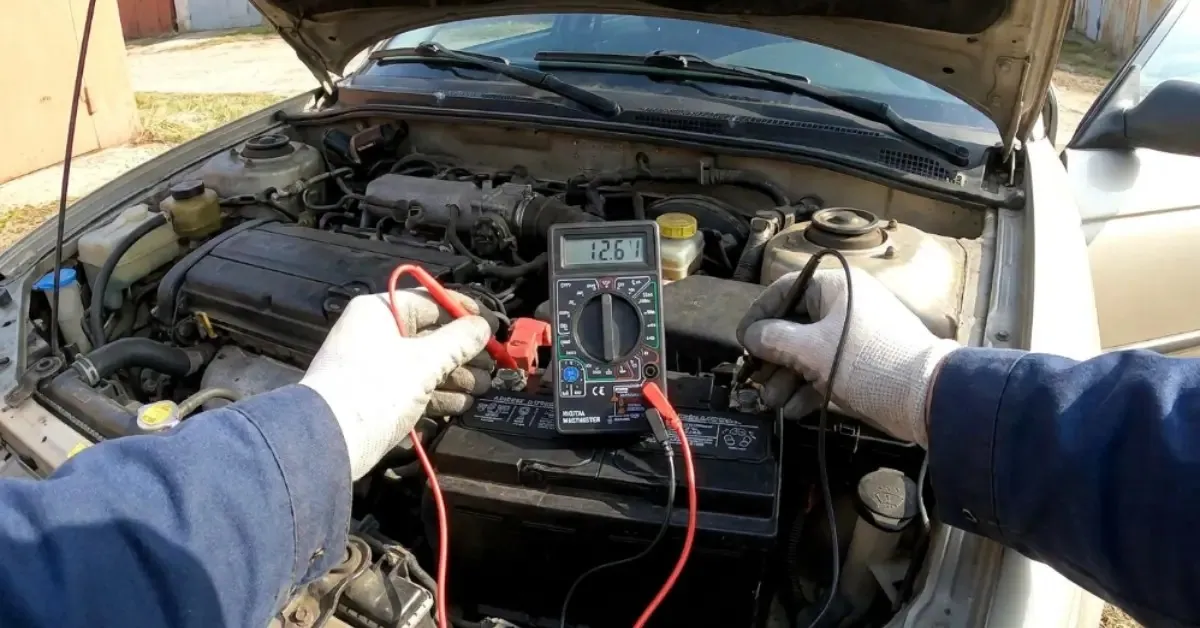
Step 5: Attach the Probes the Right Way Round
- The red lead goes on the positive post, which carries a + sign or a red cap
- The black lead goes on the negative post, which carries a minus sign or a black cap
Rest the probe tips on the posts lightly rather than jabbing them in. Keep the two tips apart the whole time they are on the battery: if they meet, you short the circuit, which can ruin the meter or throw a spark into the gas around the battery.
Step 6: Take the Reading and Work Out What It Means
Check the figure on the screen against this chart:
| Meter Reading | What It Means |
|---|---|
| 12.6V to 12.8V | Full charge, battery in good health |
| 12.4V to 12.5V | Approximately 75% charged, acceptable |
| 12.2V to 12.3V | Around 50% charged, needs charging |
| 12.0V to 12.1V | Around 25% charged, charge immediately |
| Below 12.0V | Heavily drained, might not come back |
| Below 11.8V | Probably flat for good or badly damaged |
With the engine off, a charged battery in good order shows 12.6 volts or more. A figure under 12.0 volts means it needs attention now.
Cranking Test: How the Battery Copes With a Load
The resting figure shows how much charge is stored, not whether there is enough punch to start the engine. A unit reading 12.5V on the bench can sag badly the moment the starter motor draws on it. That sag, known as Voltage Under Load (VUL), is the truer test of its health.
Leave the probes where they are and get a helper to start the engine:
- On a 12V battery the reading should stay at 9.6V or higher while the engine cranks.
- A fall to 8V or under points to a battery on its way out that will probably need replacing.
- A quick climb back above 12V once the engine fires shows the charging side is doing its job.
Working on your own? Fit crocodile-clip leads to the meter so the probes stay put while you turn the key.
That 9.6V floor is the long-standing pass mark used when starter batteries are load tested.
Running Test: Is the Alternator Doing Its Share?
With the engine now idling, keep the meter attached. A sound charging system reads as follows:
- 13.8V to 14.4V at idle, the usual charging band for a healthy system
- Over 14.7V, which suggests overcharging: get the alternator and regulator looked at
- Under 13.5V, which suggests the alternator is not putting enough back into the battery
A lot of drivers treat a flat battery as a jump-start job when the true fault is an alternator that stops refilling it on the move. Checking the running voltage adds 30 seconds and can spare you a second breakdown.
Your Reading Is In. What Next?
12.4V to 12.6V: The battery is in fair condition. Keep up the seasonal checks, and once it is past 2 years old, think about a professional load test.
12.0V to 12.4V: Put it on a good smart charger with a desulphation setting (the car sections of ACE Hardware, Carrefour and Spinneys usually stock them). Test again after a full cycle. If it will not come back up to 12.6V, the battery has worn.
Under 12.0V: The plates may have sulphated after a deep discharge. Try charging it. If the charge will not hold, fitting a new car battery is the sensible answer, as a deeply drained unit seldom recovers properly in this heat.
Under 11.0V: The battery is finished and an ordinary charger will not revive it. It has to be replaced.
Bulging, cracked or smelling of sulphur: Stop. Do not charge it or test it any further yourself, because it is no longer safe. Call in a professional battery service.
No Multimeter? Other Ways to Spot a Flat Battery
No meter in the toolbox? These 4 checks still tell you a fair amount:
- Headlights: Turn them on with the engine stopped. Strong light means reasonable charge; a faint or flickering beam means a weak battery.
- Starting sound: Turn the key and listen. A good battery spins the engine briskly. A lazy turn or a rattle of clicks is a warning.
- A look at the case: Search for corrosion, swelling, splits or leaks.
- Cabin light: A courtesy light that glows only faintly with the engine off hints at low voltage.
A Battery Calendar for the UAE Year
Batteries rarely die without warning. The damage builds for months, hastened by the heat, so time your checks to the seasons:
April to May: Before the Heat
The check that matters most. Before the 45°C+ peak arrives, read the voltage and look over the terminals. If the battery is 2+ years old, ask for a professional conductance test on equipment such as the Midtronics MDX-650. Swapping a borderline battery in May beats being stuck with a flat one on Sheikh Zayed Road in July.
June to August: High Summer
Spare the battery wherever you can. Use shade or covered parking, such as a mall basement or your building's garage. Try not to leave the car standing for more than 7 to 10 days. If you are away for Eid Al Adha or the summer break, unclip the negative terminal before you leave it.
September to October: After the Heat
Test once more when summer ends, because the heat damage adds up over the months. A good number of batteries that made it through the summer then give out in October, when cooler days bring more driving and more demand on the electrics. This is the second check of the year that you should not skip.
November to March: The Easy Months
Batteries have the gentlest time of year now. One test is still sensible if yours is near the 2-year point, above all on cars that only do short runs around Dubai Marina, Jumeirah or Al Barsha.
Home Testing Errors That Give You the Wrong Answer
These 6 slips either skew the figure or put you at risk:
- Reading a battery straight after a drive, with the surface charge still on it (run the headlights for 2 minutes first)
- Leaving corrosion on the posts, which moves the result anywhere between 0.2V and 0.5V
- Choosing AC instead of DC, when the car runs on direct current and AC shows a false value
- Shrugging off a low figure because the engine still fires (at 12.1V a battery may start the car and then fail outright a few days later, particularly in summer)
- Using the wrong range instead of 20V DC
- Letting the probe tips meet while connected, which shorts the circuit and risks the meter or a spark near the gases
When You Need More Than a Multimeter: A Professional Load Test
Voltage is all a multimeter reads. Capacity and internal resistance are beyond it. A battery with a damaged cell can sit at a normal-looking 12.5V and then fold as soon as the starter draws on it, which happens a great deal with older batteries that have been through several hard summers here.
Workshop conductance testers measure in Siemens (S) and tell you far more about how much life is left than a voltage figure can.
Book a professional test if any of these 4 describes your battery:
- Older than 2 years in UAE conditions
- Reading in the grey zone of 12.1V to 12.4V
- Passing on voltage yet labouring to start the engine
- Needing a jump-start more often than once a month
To keep a car battery going, check the voltage often, and drive for 20 minutes or more at a time so it can recharge fully. Clean and tighten the terminals so the connection stays sound. Plan to replace it after 2 to 3 years instead of waiting for it to fail. Looked after this way, it starts the engine readily, supplies steady power and lasts longer through every season.
Picking a Replacement That Suits UAE Heat
The type you choose has a direct bearing on how it copes here.
AGM (Absorbent Glass Mat) is the strongest choice. It tolerates heat, carries big electrical loads and never needs topping up, which suits the Toyota Prado, Nissan Patrol, Ford Explorer and European cars with start-stop. In this heat, expect AGM to outlast an ordinary flooded battery.
EFB (Enhanced Flooded Battery) sits in the middle, for simpler start-stop set-ups and average electrical loads.
A standard flooded lead-acid battery is the budget option and has the shortest life of the three in the harshest UAE summers.
The CCA (Cold Cranking Amps) rating has to meet what the car asks for. It reflects the power the battery actually delivers, which falls as internal resistance rises, so it matters in hot and cold places alike.
Want the Battery Tested or Replaced by a Professional?
That is the whole home check. For most people, 5 minutes with a digital multimeter settles whether the battery is the problem.
If yours has passed 2 years in this climate and a voltage figure alone leaves you unsure, the next step is a professional conductance test.
Call us and we will check the battery free of charge wherever the car is. Parked at an Arabian Ranches villa, under a DIFC tower or broken down beside Emirates Road, you get technicians who arrive with workshop-grade testers and a wide choice of battery brands, and have you moving again quickly.
Your Questions Answered
Can I book a professional test or a new battery?
Yes. The steps above are enough to tell a healthy battery from a flat one at home, and for most owners a meter and 5 minutes give a clear result.
Where the battery is 2 years old or more and has spent those years in UAE heat, a conductance test tells you more than any voltage reading, and that is the sensible next move.
Our mobile fitters test batteries free at your home, office or roadside spot, from Arabian Ranches to DIFC to Emirates Road, and carry testing kit and a full spread of brands so a failed unit can be swapped on the spot.
How frequently should a battery be checked here?
Twice a year as a minimum: April before the heat, October once it has passed. Move to every 3 months if the battery is older than 2 years or most of your journeys last under 15 minutes.
Does the battery have to come out of the car for testing?
No. Keep it fitted and put the probes straight on the terminals. That is the normal way to do it, and the safest one at home.
The engine starts without trouble. Is testing still worth it?
Yes, and more so in this climate. A weakened battery can keep starting the engine for weeks and then fail all at once. A test on your own schedule beats sitting stuck on Al Khail Road at rush hour, or in a Deira shopping centre basement.
Which voltage means the battery is truly finished?
Under 11.8 volts it usually cannot do its job, and under 11.0 volts it is as good as gone. Either way, a charger seldom brings it back to full health in UAE conditions.
Can I safely do this on my own?
Yes, provided you wear gloves and glasses, keep the space well aired and follow the steps above. Never test a battery that is visibly damaged, whether swollen, split or leaking, at home.
How is a voltage test different from a load test?
A voltage test reads the battery's electrical potential while it sits idle. A load or conductance test puts on a draw similar to cranking the engine and measures how well the voltage holds up under it, which makes it the better guide to how the battery will behave on the road.
Battery trouble in Dubai? We come to you.
On-site testing, replacement and roadside help, 24/7 across the city.