The short answer
Three things flatten a battery when the weather cools: slower chemistry inside the cells, heavier electrical demand and charging that never finishes. Even a fall of 10°C takes a noticeable share off the capacity, so a cold-morning start stops being a sure thing. Below are the causes, the early signs and the fixes, grounded in how batteries work and in real UAE driving
What Makes a Battery Lose Charge Faster When It Is Cold?
Cold hits a battery from two directions at once. Its output falls just as the car starts asking for more current, and that pairing produces hesitant starts and quicker discharge.
Slower Chemistry in the Cells
Near freezing, a fully charged unit gives up a sizeable share of its usable capacity. In practice a 60Ah battery behaves like a noticeably smaller one in the cold.
It then has trouble producing the Cold Cranking Amps (CCA) the starter wants. An ordinary passenger car calls for 400 to 600 CCA, That rating is measured at -18°C, so a healthy unit copes with a UAE winter morning; an aged one that has lost part of its rating is the one that struggles.
A Stiffer Engine to Turn Over
The engine is harder to crank because oil thickens as it cools. A 5W-30 is far thicker on a cold morning than at normal running temperature.
Thicker oil means more mechanical drag, so the battery has to deliver more current than for a start on a warm day. Supply shrinks while demand climbs, and that mismatch is the main electrical reason cold starts flatten batteries.
More Electrical Demand in the Cool Months
You simply use more power. The rear demister (120W to 300W), heater fan (150W to 250W), headlights (55W to 100W for each bulb) and wipers (50W to 100W) often run together, and the combined draw can pass 600W, loading up both the alternator and the battery.
Journeys Too Short to Refill It
After a start, a battery needs 15 to 20 minutes of unbroken driving above 50 km/h to recover. Short city trips are among the commonest causes of failure. Keep the trips short and the charge stays partial, lead sulfate crystals settle on the plates, and over 6 to 12 months up to 50% of the capacity can go.
An Alternator Not Charging Efficiently
Correct charging needs 13.7V to 14.7V from the alternator. Under 13.5V the battery never fills up, and charging it repeatedly at low voltage pushes internal resistance up and gradually shortens its life. Once internal resistance passes 10 milliohms, the unit counts as weak.
Current Drawn With the Car Switched Off
Parasitic drain is what the car consumes while it is parked. 20 to 50 mA is normal; beyond 80 mA something is wrong. A 100 mA draw takes 2.4Ah a day out of a 60Ah battery, enough to bring it to 11.8V in roughly 18 to 22 days if the car is not driven. Alarms, ECU memory, dashcams, GPS trackers and faulty wiring are the usual suspects.
An Older, Tired Battery
Every charge cycle takes a little life away. In the UAE the average unit lasts 2 to 3 years, because temperatures above 45°C hasten plate corrosion and electrolyte loss.
By year 2, many have lost 20% to 40% of their storage. Cooler weather just reveals that loss sooner.
Practical Ways to Keep a Battery Charged Through Winter
Keeping a car battery healthy in cool weather comes down to three things: complete charging cycles, sensible electrical use, and allowing for what temperature does to the chemistry. A full unit sits at 12.6V, and in winter its performance falls away fast when charging is cut short or demand runs too high.
Drive Long Enough to Recharge Fully
A cold start uses 1% to 3% of the battery's total capacity, and the alternator needs uninterrupted driving to earn it back. With normal alternator output, plan on 20 minutes or more above 50 km/h for a useful recharge.
Stick to short hops around town and the voltage creeps below 12.4V, sulfation starts building on the plates, and getting it back without a charger becomes harder each week.
Group your errands into one longer outing so the battery gets the chance to reach full charge.
Go Easy on the Load in the First Minutes
Straight after the engine fires, the battery is at its lowest, having just supplied 200A to 400A to the starter. Switching heavy consumers on at that moment piles strain on a depleted unit.
Hold off for 2 to 3 minutes before turning on the rear demister, the heater fan or main-beam headlights, so the alternator can settle its output first.
Track the Voltage and How It Charges
Voltage readings show you the state of charge (SoC) directly. At rest, the usual reference points are:
12.6V means fully charged, 12.4V is roughly 75%, 12.2V is roughly 50%, and anything under 12.0V is a deep discharge that risks lasting damage to the plates.
With the engine on, the alternator should read 13.7V to 14.7V. Below 13.5V it is not charging enough, and the battery will slowly run down over your daily journeys.
Take a reading with a digital multimeter once a week. It is a quick habit that spots a falling voltage long before the car fails to start.
Keep Charging Consistent to Stop Sulfation
Sulfation is lead sulfate (PbSO4) crystallising on the plates. It is one of the commonest causes of premature battery failure.
It starts once a battery spends long spells under 12.4V and turns semi-permanent after more than 48 hours below 12.2V. It can strip away up to 50% of usable capacity and push internal resistance up sharply.
Do not let the battery linger half charged. For a car parked more than 5 days, hook up a smart maintenance charger with a desulfation mode.
Clean the Terminals So Current Flows Freely
The terminals need to pass current with as little resistance as possible. Even a thin layer of corrosion adds resistance, and with the starter drawing hundreds of amps, a few milliohms is enough to cut the current reaching it on a cold start.
A poor connection shows up as a slow response when you turn the key, warm spots at the terminal contacts, and more than 0.3V lost between the post and the cable end under load.
To clean them, disconnect the cables, apply a mix of baking soda and water, scrub with a brass wire brush, rinse, dry completely and reconnect firmly. Finish with a coat of anti-corrosion grease.
Keep Parasitic Drain in Check
In a modern car the drain at rest normally sits between 20 and 50 mA. More than 80 mA is too much and will noticeably cut the battery's life.
A 100 mA drain costs a standard 60Ah battery 2.4Ah a day, taking it from 12.6V to under 12.0V inside 10 to 14 days of standing.
Frequent culprits are relays stuck closed, dashcams left on with no low-voltage cut-off, aftermarket GPS trackers pulling more than 30 mA, and ECU memory modules with software faults.
If the battery goes flat with no clear reason, run a parasitic draw test with a clamp-type milliamp meter, pulling fuses one by one to find the circuit responsible.
Do Not Leave the Car Idle for Long Without Support
A battery loses around 5% of its charge a month by itself at 25°C, and more with a parasitic load or in warmer weather.
Left standing, a car shows a clear voltage drop after 5 days, starting trouble by about day 10, and a high chance of failure after 2 weeks or more with no charge.
Run the engine every 3 to 4 days for at least 15 to 20 minutes, at idle or on a gentle drive. Or connect a smart maintenance charger, sometimes called a battery tender, which keeps it topped up without overcharging.
Make Sure the Alternator Keeps Up Under Load
The alternator has to charge the battery and power everything that is switched on at the same time. If it is weak, the battery makes up the difference and discharges even as you drive.
Output should be at least 13.7V, with 13.7V to 14.7V the ideal band. Under 13.5V is undercharging; over 14.8V risks overcharging and boiling off electrolyte.
A failing alternator gives itself away through a battery that runs down despite regular long drives, headlights flickering at idle, a battery light that comes and goes, and a whine or grinding from around the pulley.
Check it with a digital multimeter on the battery terminals, engine running and the big electrical loads switched on. If it reads under 13.5V at full load time after time, the alternator needs replacing.
Choose Where You Park to Limit the Cold
The electrolyte grows less active as it cools. Each fall in air temperature takes a little more off the capacity it can deliver.
On winter nights in the northern emirates the air can drop to 5°C to 10°C, enough to cut output noticeably against the daytime figure.
Use covered or indoor parking where you can. Shade by day keeps the battery's temperature steadier, and underground car parks stay more even than open ones.
Change an Ageing Battery Before It Fails
Capacity falls with each charge and discharge, and a starter battery is not built for many deep ones. Its cold cranking and reserve capacity ratings are tested to the SAE J537 standard.
Here the typical life is 2 to 3 years, as the summer heat speeds corrosion and water loss inside. Past year 2, capacity is often under 70% of the original Ah rating.
If it regularly sits under 12.4V at rest, or will not hold charge after a full session on a charger, a replacement makes more financial sense than jump-start after jump-start or endless charging.
Care Through the Seasons for a Longer-Lived Battery
How a battery performs shifts with the temperature, the way you drive and the load you put on it. Skip seasonal care and it can last 30% to 50% less than one that is looked after.
In Winter
Cooler air lowers output and makes starting harder, and even the mild UAE winter shows up on chilly mornings.
- Hold the resting voltage at 12.6V. That keeps starting power steady and slows sulfation on cool nights.
- Drive for 15 to 20 minutes without stopping, so the alternator can finish a full recharge and restore State of Charge (SoC).
- Time how long the engine takes to fire. Cranking that runs noticeably longer than usual points to lost capacity.
In Summer
Heat speeds up the reactions inside and harms the plates and separators.
- Find shade or cover. Past 40°C, electrolyte loss quickens and 6 to 12 months come off the battery's life.
- On flooded batteries that can be opened, check the electrolyte. A low level leaves the plates exposed and damages them for good.
- Watch for overcharging. More than 14.8V boils off electrolyte and warps the plates.
In Wet or Humid Spells
Moist air speeds up terminal corrosion and degrades the connection.
- Keep the terminals clean and dry, since moisture raises contact resistance and cuts cranking current.
- Look them over every 4 to 6 weeks. A loose or corroded joint can lose 0.5V to 1.0V while the engine cranks.
- Shield the battery from splashes. Water on the surface can open small leakage paths between the terminals.
All Year Round
A few basics help in every season.
- Read the voltage each month: 12.6V at rest and 13.7V to 14.7V with the engine on.
- Every 3 months, confirm the terminals are clean and tight so the full current reaches the starter.
- Use the car often. Standing idle, a battery slowly sheds charge by itself, faster in the heat.
Have it load tested every 6 months. Under 70% of its Ah capacity, it is due for replacement.
Your Battery Just Died. What Now?
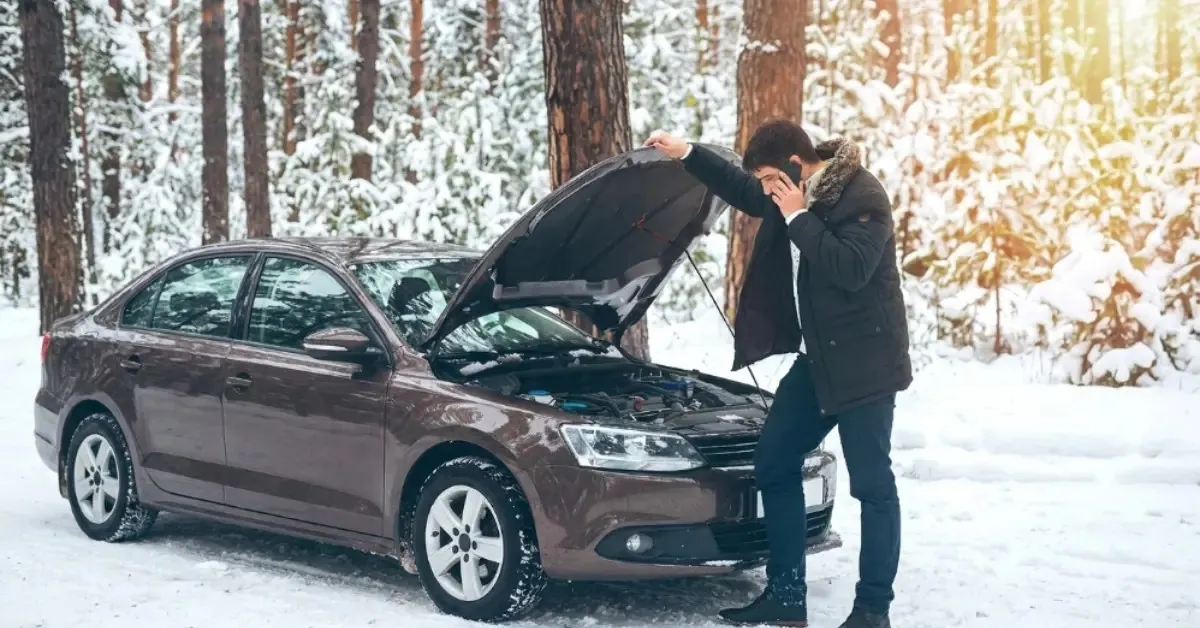
A battery can quit with little warning, especially in winter, when its efficiency is already down. Responding quickly and in the right order gets you going safely and protects the electrics.
What to Do Straight Away
- Keep calm and look at the dash. Turn the key once: if the lights are faint or do not come on, the voltage is probably under 11.8V, too low to engage the starter.
- Switch everything off. Headlights, AC fan, rear demister and infotainment should all be off before another try, so the battery can put every available CCA into starting.
- Wait 30 to 60 seconds, then try again. A short pause lets a partly flat battery recover a little surface charge.
- If there is another car nearby, use jump leads. A jump usually works while the flat battery is above 10.5V. Join positive to positive, and fix the negative lead to an unpainted metal earth point instead of the flat unit's own negative terminal.
- After a successful jump, leave the engine running for at least 20 to 30 minutes, giving the alternator time to bring the battery back above 12.4V.
- No response even after a jump? Ring roadside assistance. The battery may be below 10V or damaged inside.
What Not to Do
- Do not crank again and again in quick succession. Each attempt drags the voltage under 10V, makes recovery harder and overheats the starter motor.
- Do not leave the lights or AC running while the battery is weak. Every extra watt empties it faster.
- Do not get the jump leads wrong. Reversed polarity (positive to negative) can instantly damage the ECU, the alternator diodes and other delicate electronics.
- Do not shrug off a battery that lets you down more than once a week. That is a clear sign it holds under 50% of its rated capacity and needs replacing now.
- Do not set off straight after a jump without checking the alternator. If it is putting out under 13.5V, the battery will not recover and will soon be flat again.
Getting a Professional Check in the UAE
A slow start, lagging electrics or trouble at the ignition are all reasons to have the car battery looked at. They usually mean the voltage is under 12.4V, the alternator is weak, or the unit is more than 2 years old.
We offer battery testing, charging system checks and battery replacement across the country. Our technicians use load tests and voltage readings to pin down the fault before the battery gives out completely.
Summary
Winter flattens batteries because the cold slows the chemistry inside, while lights, the heater and short journeys add to the load. Even a drop of 10°C costs it a noticeable slice of capacity.
To stay ahead of it, read the voltage regularly and give it drives of 20 minutes plus to recharge. Scrub and tighten the terminals for a solid connection, and replace the battery at 2 to 3 years before it strands you. Treated like this, a battery gives quick starts and even power, and it outlasts a neglected one in every season.
Questions Drivers Ask
How can I keep my battery from dying when it is cold?
Hold the resting voltage at 12.6V and avoid journeys under 15 minutes. Switch every electrical system off before you stop the engine, and give it 20-minute-plus runs at ordinary road speeds so the alternator can complete a full recharge.
How many years will a battery last through cooler seasons?
A sound battery gives 2 to 3 years in a climate like the UAE's and as long as 3 to 5 years in cooler places, if it is cared for. Lots of short trips, summer heat above 40°C and repeated deep discharges all cut that figure considerably.
Will idling recharge the battery in winter?
It does, but slowly. At idle the alternator gives only around 30% to 50% of its maximum current, so driving at ordinary road speed recharges the battery 2 to 3 times more effectively.
Varta designs its AGM batteries for newer cars fitted with start-stop.
Bosch is a reliable alternative that suits a broad range of vehicle types.
At what reading is a battery considered weak?
A reading under 12.4V at rest, engine off, points to a weak battery. Under 12.2V it is at half charge or less and may not start the engine on a cold morning
How often should the car be driven in winter to avoid a flat battery?
Take it out at least 2 to 3 times a week, for 20 to 30 minutes of uninterrupted driving each time, so the alternator can charge it back above 12.6V.
Can I test the battery myself at home?
Yes, with a digital multimeter on the DC voltage setting. A healthy battery shows about 12.6V with the engine off and 13.7V to 14.7V with it running. Under 12.4V at rest means it is partly discharged or has lost capacity.
What helps a battery last longer through winter?
Skip the short trips, keep the terminals free of corrosion and drive for at least 20 minutes each time. Keep the resting voltage at 12.6V, never leave the headlights or electronics on with the engine off, and use a maintenance charger over any long lay-up.
Battery trouble in Dubai? We come to you.
On-site testing, replacement and roadside help, 24/7 across the city.